Yeung, P. H. (2026). Should we use ASR in sociophonetic research? Benchmarking WhisperX for downstream vowel analysis [Manuscript submitted for publication]. Department of Linguistics, Georgetown University.
Computational methods in sociolinguistics
While analyzing field recordings for my dissertation, I began using automatic speech recognition (ASR) systems such as WhisperX and CrisperWhisper 2.0 to transcribe English–Malay code-mixed speech, and large language models (LLMs) such as Qwen3.8-27B and gpt-oss-120b to extract participants' responses from the transcripts.
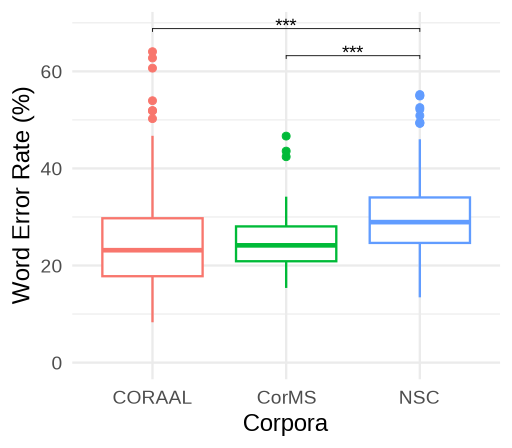
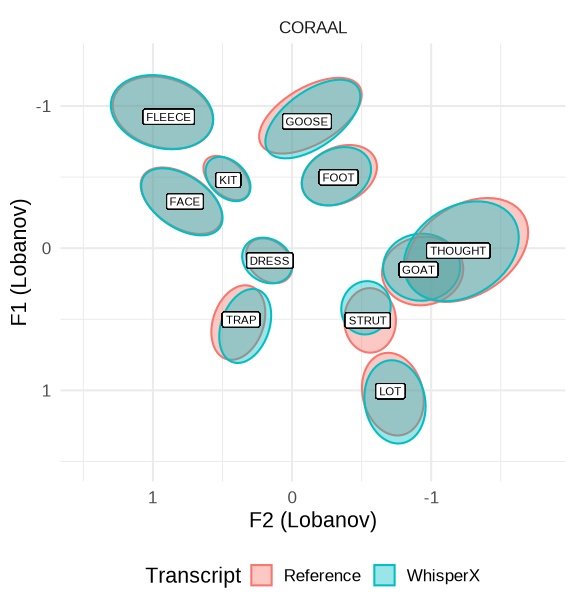
These tools saved me a lot of time, but they also made me wonder how far they can be trusted for linguistic research. So I set out to test how reliably ASR systems transcribe speech, and whether using them for transcription changes the phonetic measurements that follow. I tested WhisperX against 778.8 hours of English conversational speech from three sociolinguistic corpora. Preliminary results indicate that vowel measurements derived from WhisperX differ systematically from those derived from manual transcriptions, suggesting that errors introduced during automated speech processing may affect downstream phonetic measurements. The findings highlight the necessity of human revision of ASR outputs in sociophonetic research (Yeung, 2026).
Apart from my ASR benchmarking work, I've also written tutorials on how to transcribe linguistic data using WhisperX and convert .srt subtitle files to Praat TextGrids.